Monday, October 28, 2013

Day 41 - The Storm of the Century in UK Headlines

Sunday Night
Commuters are being warned of travel disruption on Monday as a storm bringing severe gale-force winds starts moving across England and Wales.

Train companies have cancelled early-morning services, and flights into London have been reduced.

Gusts of up to 80mph (130km/h) are predicted as the weather hits the South West then moves north and eastwards and there are fears of flooding and damage.

The prime minister has chaired talks about plans to protect the public.

Meanwhile the search for a missing 14-year-old boy who was swept away by the sea in East Sussex has been suspended.

Waves in Newquay Cornwall


Travel warnings included:

South West Trains have advised people not to travel on Monday with most services not running until at least 08:00 GMT to allow Network Rail to check lines. A reduced timetable will be in operation, with some trains limited to speeds of 50mph
East Coast will operate a revised emergency timetable on Monday, with trains stopping at Peterborough until 10:00 GMT, and limited to speeds of 50mph afterwards
First Great Western and Virgin West Coast main line are also running an amended service until 10:00 GMT and 09:00 GMT respectively
First Capital Connect and C2C said services are unlikely to begin until 09:00 GMT. Greater Anglia, Southern and Gatwick Express have said services on Monday will not run until it is declared safe to do so
London Overground will not run a service on Monday before 09:00 GMT, while First Great Western has warned of extended travelling times and Southeastern said it is likely to start running services late
Airports including Heathrow and Gatwick are warning of possible disruption to flights, advising passengers to check with airlines
Airlines operating in and out of Heathrow have been instructed to reduce their schedules by between 5% and 20% between the hours of 06:00 GMT and 22:30 GMT, leading to about 60 flight cancellations. It is not yet clear how many of those will be short-haul or long-haul flights
EasyJet has warned passengers there could be disruption to flights on Monday. It said no trains would run to Gatwick, Southend, Stansted or Luton airports before 09:00 GMT
Eurostar said it will not be running trains on Monday until 07:00 GMT, with early services from London and Brussels subject to delays. It expects to run a full service after 07:00 GMT and passengers are advised to arrive at the scheduled time
Several ferry companies have also cancelled services, including some English Channel and Irish Sea crossings
Several bridges including the M48 Severn Crossing, the A249 Sheppey Crossing in Kent, and the Tamar Bridge which joins Cornwall and Devon are closed. There also are plans to shut the M4 Severn bridge and the Queen Elizabeth II bridge on the M25 on Monday morning, with traffic directed through the tunnel part of the crossing
The Highways Agency is advising motorists to check the weather forecast and road conditions before they travel

Stranded Passengers at Kings Cross Station
Four people have died after a storm battered southern Britain, leading to 625,000 homes losing power, and major rush-hour disruption to commuters.

A teenager in Kent and a man in Watford were killed by falling trees.

A man and a woman died in west London after a falling tree caused a suspected gas explosion and a house to collapse.

Many rail companies suspended morning services before running reduced services later. They say operations will be back to normal on Tuesday.

Flights and ferry crossing were also affected as the storm moved across Britain.

BBC forecasters say the storm, which began on Sunday night and saw heavy rain fall across many areas and wind speeds of more than 70mph, moved out of the UK shortly after 12:00 GMT - leaving a "broadly windy day" behind.

Needles Old Battery - Isle of Wight
The strongest gust of 99mph (159km/h) during the storm was recorded at Needles Old Battery, Isle of Wight, at 05:00 GMT.

Mobile Home Crushed by tree - killing teen
Bethany Freeman, 17, suffered fatal injuries when the tree came down on the caravan where she was sleeping in Hever, near Edenbridge, at about 07:20 GMT.

The caravan was next to the house she lived in with her family and she had been sleeping there while renovations were carried out.

Donal Drohan, 51, from Harrow, was pronounced dead at the scene after a tree crushed a red Peugeot 307 at Lower High Street in Watford, Hertfordshire, at 6:50 GMT.

Mark Joseph, who was passing by before the emergency services arrived, said: "We tried to assist, trying to get the tree off, but it was impossible... The poor chap didn't stand a chance."

West London
The man and women who died in west London were found after three houses collapsed and two others were damaged following a gas explosion after a tree fell during high winds in Hounslow, the London Fire Brigade said. Three people injured in the incident were taken to hospital.

The search for the 14-year-old boy - who has been named as Dylan Alkins - who was swept away in Newhaven, East Sussex on Sunday has resumed

Bus overturned in Suffolk
A double-decker bus rolled over in Suffolk, injuring the driver and several passengers. Witnesses told police the vehicle blew over at 08:00 GMT, rolling onto its side and coming to a stop in a field in Hadleigh
Both reactors in Dungeness power station's B units were automatically shut down after power to the site was cut off. The site's own generators are providing power to the site.

The Metropolitan Police says it received 792 calls to its 101 and 999 numbers between 06:00 and 08:00 GMT, compared with the 200 it would normally expect. The most common call was for "tree in road"

Southwest Tracks in Alton Hampshire
Police say 125 trees fallen across Sussex including one on a taxi in Eastbourne, from which the driver climbed out uninjured.
The helter-skelter at Clacton Pier in Essex has blown down.
London Mayor Boris Johnson has chaired an emergency resilience meeting involving all emergency services and relevant agencies - and later made a statement thanking them for their work.

Collapsed crane on the roof of the Cabinet Office
Deputy Prime Minister Nick Clegg cancelled his monthly press conference after a crane collapsed on the roof of the Cabinet Office

Storm as of 00:00 Monday 10/28
We had some gusty winds in our area, but our trees are all fairly small in this area and protected by taller buildings.  Throughout the night it sounded like shutters were beating against the windows.  The streets were wet, but it was no longer raining by 10:00 AM.

Sunday, October 27, 2013

Day 40 - Spankings, Football, Calton Hill and a Marks & Spencer Dinner

Today I spent most of the morning and afternoon going through all the Spank or Treat and Saturday Spankings entries and leaving a comment.  So, no touristy stuff to report from me.  Hubby went looking for a model store that has closed and a search for the third BBC Dr. Who magazine, so not much to report from him either.

NFL in London
This afternoon marked the second NFL game being played in London this year.  During it, the San Francisco 49ers won their fifth straight game, crushing the winless Jacksonville Jaguars 42-10 at Wembley Stadium.

Christmas Decorations are beginning to be put up with various lighting cermonies around the city reportedly happening next week.  There's a tree up in Covent Garden, but it's not decorated, yet, and though the decorations on our street are all up, they still aren't lit either.  We spoke briefly with the gents last week who were working to install them, and they said their company was responsible for the decorations on both Oxford and Regent Street as well as Covent Garden.

Next week, I hope to be able to share pictures of decorated streets, but in the meantime I'll share a few more photos from Edinburgh that I wasn't able to share earlier.

Calton Hill in Edinburgh
Calton Hill is the headquarters of the Scottish Government, which is based at St Andrew's House, on the steep southern slope of the hill; with the Scottish Parliament Building, and other notable buildings, for example Holyrood Palace, lying near the foot of the hill.includes several iconic monuments and buildings: the National Monument, the Nelson Monument, the Dugald Stewart Monument, the old Royal High School, the Robert Burns Monument, the Political Martyrs' Monument and the City Observatory.

Martyrs Monument on Calton Hill
The Old Calton Burial Ground was the first substantial development on Calton Hill and lies on the south-western side of the hill. The philosopher David Hume is buried there. His tomb is engraved only with the year of his birth (1711) and death (1776), on the "simple Roman tomb" (a relatively large monument) which he prescribed. The Political Martyrs' Monument is also in the burial ground. This is in memory of five campaigners for political reform and universal suffrage who were convicted of sedition and sent in 1793 to Botany Bay, Australia.

Edinburgh from the Calton Hill with Calton Jail in foreground, by George Washington Wilson, albumen print, ca. 1865-1895
Calton Hill was the location of the notorious Calton Jail, a complex comprising a Debtors' Prison, the Bridewell (1791-96) by Robert Adam (later replaced) and a Felons' Prison of 1815-17 by Archibald Elliot. The jails were replaced by Saughton Prison and demolished in 1930 providing a site for St. Andrew's House, home to Scotland's senior civil servants. The sole surviving building is the castellated and turreted Governors House.

The Governor's House on Calton Hill
The Governor's House, designed by Archibald Elliot (1761-1823) who was also responsible for the nearby Waterloo Place and Regent Arch, is a building situated on the southernmost spur of the Calton Hill beside the south-east corner of Old Calton Burial Ground. It looks out over Waverley Station, the Canongate and Holyrood Park to the south.

As was mentioned before, this building is all that remains of the Calton Gaol, once the largest prison in Scotland, completed in 1817. The House contained the Committee Room used by the Commissioners who governed the prison. Its castellated and turreted form is similar to James Craig's Old Observatory House on the Calton Hill, but its design was more likely influenced by Robert Adam's older 'Bridewell' of 1791, which stood alongside the newer prison. The Gaol closed in 1927 and, except for the Governor's House, was demolished in the 1937 to make way for St Andrew's House.

The National Monument as seen from the Nelson Monument
Playfair was responsible for many of the monumental structures on the summit of the hill most notably the Scottish National Monument. This monument was intended to be another Parthenon and to commemorate Scottish Soldiers killed in the Napoleonic wars. Construction started in 1826 but work was stopped in 1829 when the building was only partially built due to lack of money. It has never been completed.For many years this failure to complete led to its being nicknamed "Scotland's Disgrace" but this name has waned given the time elapsed since the Napoleonic Wars and it is now accepted for what it is.

Horatio Nelson Monument
The Nelson Monument is a commemorative tower in honour of Vice Admiral Horatio Nelson, situated on top of Calton Hill, in Edinburgh, Scotland and provides a dramatic termination of the vista along Princes Street from the west. It was built between 1807 and 1815 to commemorate Nelson's victory over the French and Spanish fleets at the Battle of Trafalgar in 1805, and his own death at the same battle. In 1853 a time ball was added, as a time signal to shipping in Leith harbour, and to ships at the anchorage in the Firth of Forth known as Leith Roads, allowing the ships to set their chronometers.

The Time Ball on Nelson's Monument
The time ball was the idea of Charles Piazzi Smyth, the Astronomer Royal for Scotland, and was originally triggered by a clock in the adjacent City Observatory, to which it was connected by an underground wire. The mechanism was the work of Maudslay, Sons & Field of Lambeth, who had previously constructed the time ball mechanism for Greenwich Observatory. The installation was carried out by James Ritchie & Son (Clockmakers) Ltd, who are still retained by City of Edinburgh Council to maintain and operate the time ball.

The ball, constructed of wood and covered in zinc, and weighing 762 kilograms (1,680 lb), is raised just before 1pm, and at precisely 1pm, is dropped from atop the mast. Later, in 1861, the One O'Clock Gun was established at Edinburgh Castle to provide an audible signal when fog obscured the time ball. The time ball was operated for over 150 years, until it was damaged by a storm in 2007. In 2009, as part of the restoration of the monument, the time ball was removed, and the mechanism repaired. The time ball was brought back into service on 24 September 2009.] The mechanism is now operated manually, based on the firing of the One O'Clock Gun.

The Dugald Stewart Monument
The Dugald Stewart Monument is a memorial to the Scottish philosopher Dugald Stewart (1753–1828). Situated on Calton Hill, the monument  designed by William Henry Playfair, was completed in August 1831. Dugald Stewart was a professor at the University of Edinburgh, holding the chair of moral philosophy from 1786 until his death. The Royal Society of Edinburgh commissioned the monument and selected its site in 1830.

The monument, modeled on the Choragic Monument of Lysicrates in Athens, is a circular temple of 9 fluted Corinthian columns around an elevated urn. This example of the architecture of ancient Greece had been brought to wider attention by James "Athenian" Stuart and Nicholas Revett's illustrated survey, The Antiquities of Athens, published in 1762. The Choragic Monument also provided the model for the nearby Robert Burns Monument, designed by Thomas Hamilton around the same time. 

Robert Burns National Memorial in Edinburgh
Following the erection of a mausoleum on the grave of Robert Burns (Scotland's National poet) in Dumfries in 1815 there was a general move for memorials and statues of the bard in other Scottish towns and cities.

After a large subscription from Scottish expatriates in 1817 from India, a monument in Edinburgh was funded with Thomas Hamilton winning this commission, after several years of debate, in 1831, largely repeating the Alloway design, but designed to contain a full sized statue of Burns by John Flaxman. The statue was later removed to the Scottish National Portrait Gallery where it remains on display.

Although the Alloway monument is accessible all year round, sadly the Edinburgh memorial is only accessible on special occasions such as Doors Open Day (usually one weekend in late October in Edinburgh).

The Old Royal High School on Calton Hill
After the Old Royal High School was vacated in 1968, the building became available to house the proposed devolved Scottish Assembly, and was accordingly refurbished in the 1970s. However, the 1979 devolution referendum failed to provide sufficient backing for a devolved Assembly in Scotland. Instead the building has been used as offices for departments of Edinburgh City Council, including The Duke of Edinburgh's Award unit and the Sports and Outdoor Education unit.

The City Observatory on Calton Hill
The City Observatory, also known as Observatory House, the Old Observatory, or after its designer James Craig House, is an astronomical observatory located on Calton Hill. The central building with the appearance of a Greek temple is the Playfair Building, named after the building's designer William Henry Playfair. This houses the 6-inch (15 cm) refractor in its dome and the 6.4-inch (16 cm) transit telescope in its eastern wing. The largest dome of the site is the City Dome in the northeast corner. During the early 20th century this contained a 22-inch (56 cm) refractor.

Calton Hill, along with Edinburgh Castle, is to Edinburgh what the iconic Big Ben is for London.  Views of, and from, the hill are often used in photographs and paintings of the city.

I have a few more photos of Edinburgh to share with you, but we had our time change last night, so even though the clock says it's only 2 AM, my body is telling me it is 3 AM, so I'm going to share one more thing with you, then say goodnight.

Hubby purchased a dinner from Marks and Spencer, which included a bottle of wine, lasagne, veggies, and profiteroles, which are like tiny eclairs in a small, round pastry shape all for 10 GBP.  He added the salad of cucumbers, greens, red onions and cherry tomatoes.  Very good.

Eating Dinner around the computer
I'll check in again tomorrow.  Good night. 


Saturday, October 26, 2013

Day 39 - A Date with Eternity

From Here to Eternity
Today, while I was working on my blogs, hubby braved the windy weather and procured tickets for us to the new musical, which opened on Oct. 23, From Here to Eternity.

Soldiers in the barracks
It received mixed reviews, which probably accounted for a less than full audience on only it's third day out. In Paul Taylor's review for the Independent, he wrote, "The aim is a grittier, sexier low-down on life in the US army and the show – with lyrics by Tim Rice and music by newcomer Stuart Brayson – certainly gives you a powerful sense of men, thrown by poverty into this substitute family, and the nervous energies that are barely held in check by the furious military drilling in Javier de Frutos's testosterone-fuelled choreography."

Kiss on the Beach
I agree the show is a lot grittier than the movie, so it is reportedly more faithful to James Jones's novel.  I also felt that the scenes with the men of company G were probably the strongest, and that's part of the problem. They should be rousing, but the best scenes should be those of the principals, and unfortunately that wasn't the case
Rehearsal for the Kiss Scene
Taylor goes on to say, "An air of unintended embarrassment hangs around the illicit passion between Darius Campell's tall, dark and lecherous First Sergeant Milt Warden and Karen (Rebecca Thornhill), the neglected wife of his boss. There’s no sizzle in the wise-cracks, and though the first act climaxes, rather laughably, in a spot of rear-view nudity, there is little erotic spark between them."

Sergeant Warden and Karen
He's right that Karen and Milt's relationship lacks electricity, because for some reason the most emotional scenes are played without any emotion at all.  Not even a struggle to keep the unwanted emotion at bay. The characters could as well be talking about a frustrating day at the grocery store than the fact that Karen had to have a hysterectomy because her unfaithful husband gave her gonorrhea, taking away all chance of her ever having a child.  That moment should have been fraught with anger and frustration and perhaps even tears on Karen's part as she tries to explain to her lover why she's now being unfaithful to her husband, but she's dry-eyed leaving the audience equally untouched by her plight.

Warden, Karen, Lorene, Prewitt
I didn't think the first act climax was laughable, but I wanted a better connection between all four of the principals.  Problem is none of them is really likable.  Karen's husband, who serves as the commanding officer for the company, refers to his unfaithfulness as "one small mistake."  Karen has become cold and emotionally distant from her husband and any other man she chooses to sleep with.  Sergeant Walker is known as a handsome lech, so he's got some strikes against him before he and Karen get together. Private Prewitt (the second male lead) has a past he regrets, so he's determined to remain emotionally distant, and the woman he eventually falls in love with (Lorene) is paid to have sex with other men, so she has to keep her emotions in check.  Because of their situation, all four of these characters need to grow until at one point they feel so strongly it hurts them, and we (the audience) need to experience their growth pains, so that we care what happens to them and want them to succeed with all our heart.  Instead, we watch them go through the show without ever opening themselves up to the hurt of loving someone.  They say they love, but we don't believe them.  We can't because they refuse to let us in.

Ryan Sampson Curtain Call
The best actor in the show was Ryan Sampson, whose portrayal of the jesting, bullied-to-death Maggio reminded me of a young Al Pacino.  His wisecracking and emotionally open character was a relief when compared to the other actors, and he received the greatest applause as well.


Shaftesbury Theatre
The ending is emotionally rousing considering that almost all the soldiers die.  And though we are disappointed that the women do not end up with the men they claim to have loved, we feel much more for the innocent soldiers who lost their lives to the Japanese bombing of Pearl Harbor.

I think the show has great potential, but they need to make the primary characters more likable, or we won't care what happens to them in the end.


Charles, Prince William, and Diana
On a slightly different topic, I wanted to add information about HRH George of Cambridge's Christening at St. James Palace on the 23rd, while we were in Cambridge.  I doubt we would have gotten close enough to capture any good photos as some of the pictures below will reveal the crowds around the palace, but I'm sorry we missed the event entirely.  Most of text below comes from the Daily Mail article I refer to at the end of this post.  Please refer to it if you'd like more information and pictures. (Note: most of the pictures can be viewed as larger images if you click on them).


Official portrait of the Duke and Duchess of Cambridge with a happy Prince George
The official portrait for the christening of Prince George Alexander Louis of Cambridge, HRH Duke of Cambridge and HRH Duchess of Cambridge, in The Morning Room at Clarence House in London on Oct. 23rd 2013.

Kate wore Alexander McQueen to Baby George’s christening, but the Prince one-upped his fashionista mother with a hand-made Honiton lace dress fashioned after the christening gown worn by every royal baby since 1841.


Prince William's Christening
Front Row: Queen Elizabeth II, Diana holding William, the Queen Mother
Back Row: Charles and Prince Phillip


Front Row Queen, Kate and William
Back Row Prince Phillip, Charles, Camilla, Harry, Pippa, James, Carole and Michael Middleton
According to aides, there wasn’t ‘even a peep’ out of the three-month-old future king as he was baptised by the Archbishop of Canterbury, the Most Rev Justin Welby, at the Chapel Royal in St James’s Palace.

ROYAL ORDER OF SERVICE: THE BAPTISM OF PRINCE GEORGE 

The Duke and Duchess of Cambridge asked their siblings to do readings at Prince George's christening service.
Harry read a passage from the gospel of St John (15: 1-5), which begins 'I am the true vine, and my Father is the gardener', while Pippa read the famous 'Suffer little children that they come unto me' passage from the gospel of St Luke (18:15-17).
The Archbishop of Canterbury, the Most Reverend Justin Welby, baptised Prince George, supported by the Dean of The Chapel Royal, the Rt Rev Richard Chartres, and the Sub-Dean of the Chapel Royal, the Rev Prebendary William Scott.
The two hymns sung at the service were Breathe On Me, Breath Of God, and Be Thou My Vision.  
Blessed Jesu! Here We Stand was written for Prince William's baptism on 4 August 1982, and the anthems were performed by the Choir of Her Majesty's Chapel Royal.
The processional altar music was Bach's Fantasia in G (BWV 572), while the recessional altar music was Widor's Toccata from Symphony No.5.

‘He went in smiling, came out smiling and, as far as we are aware, smiled throughout,’ said one.

William, however, could not resist confiding: ‘It’s the first time he’s been quiet all day.’
The Archbishop of Canterbury told the congregation in the Holbein-painted chapel that George’s parents and godparents had a ‘simple task’ – to ‘make sure he knows who this Jesus is’.

The simplicity of the half-hour ceremony contrasted with the historic grandeur of the surroundings.


St. James's Palace
The heart of Mary I is buried beneath the choir-stalls of St. James's Palace and Elizabeth I prayed there for the defense of the realm against the Spanish armada in 1588.

Adding some gravitas is the note that it was in the Chapel Royal that Diana’s body lay before her funeral in Westminster Abbey in 1997. Kate also chose the chapel to be confirmed into the Church of England before her marriage to Prince William in April 2011.


Crowds around St. James Palace
George’s life too, is already steeped in history. The Archbishop made the sign of the cross on his head with water taken from the River Jordan, in a royal tradition that dates back to the 12th century.


Silver Lily Baptismal Font in Chapel Royal of St. James Palace
The water was poured into the silver Lily Baptismal Font which was commissioned by Queen Victoria and Prince Albert in 1840 and has been used at every royal christening since.


Godmother to George Zara Phillips with husband Mike Tindall
His parents’ guest list for the christening – which left out senior members of the family including Prince Andrew, Prince Edward and Princess Anne – was a surprise to some. It did, however, result in the ‘intimacy’ the Duke and Duchess of Cambridge craved.

Indeed, there were just 23 guests present, giving the christening a feel of a family gathering rather than the moment a future Supreme Governor was presented to his Church.

Earlier, Kensington Palace unveiled the long awaited list of godparents. Among the seven, there was no royalty, just a smattering of close friends, relatives and advisers.

They are Oliver Baker, Kate and William’s flatmate at St Andrew’s, interior decorator Emilia Jardine-Paterson, William’s cousin Zara Tindall and his  childhood friend William van Cutsem, one of William’s most trusted confidantes.


At just 22, Hugh, Earl Grosvenor, was the youngest. He is the son of one of the country’s richest men, the Duke of Westminster, whose wife, Natalia, is one of William’s godmothers.


Family friends: Prince George's godparents Julia Samuel, a close friend of the late Diana, Princess of Wales, and the Duke of Westminster's son Hugh Grosvenor, right, are pictured arriving with the Hon. Mrs Samuel's husband, Michael, left
For the Queen it was very much business as usual. She broke away from her schedule for only an hour – and was last night busy hosting a charity reception at the Palace.


Queen Elizabeth II and Prince Phillip with Charles and Camilla in the background
Shortly before 3pm on the 23rd, the family gathered at St James’s Palace to await the Queen.
The guests filed in, including Carole and Pippa Middleton, Kate’s heavily bearded brother James and William and Kate followed with baby George Alexander Louis.

The Queen was the last to walk in, accompanied by the Duke of Edinburgh. She wore a diamond, ruby and sapphire floral brooch that her own parents had given her on the birth of Prince Charles in 1948.


The prince bounced his baby son up and down as Kate, radiant in a cream Alexander McQueen ruffled outfit with a jaunty Jane Taylor hat, beamed proudly.


Kate holding George
With its long, flowing skirt, Prince George’s fairytale christening gown was a vision to behold. But the third in line to the throne was swathed in much more than layers of intricate lace and satin when he was popped into the robe yesterday.  He was also wrapped up snugly in 172 years of royal history.

The elaborate cream gown is a handmade replica of one worn by Queen Victoria’s eldest daughter, Victoria, the Princess Royal, at her christening in 1841, and then passed down as an heirloom. The original, made of the same fabric as the wedding dress Queen Victoria wore for her marriage to Prince Albert in 1840, went on to be worn by generations of royal babies – 62 in all, including Victoria’s eight other children.


Every British monarch since Edward VII wore it, including the Queen when she was christened in 1926. So did all four of her children, all her grandchildren and other royal babies.


Created by Janet Sutherland, a Falkirk coal miner’s daughter, it was delicately crafted from Spitalfields silk, given a satin weave to make it glossy, and trimmed with lace from Honiton, East Devon.

The gown was hand-washed in spring water and carefully stored in a cool, dark place to keep it pristine. But in 2004, after the christening of Lady Louise Windsor, daughter of the Earl and Countess of Wessex, the cherished antique was deemed too fragile to be used again and went into retirement, preserved at Buckingham Palace.


So loved was it, however, the Queen commissioned an exact replica from her dresser Angela Kelly – with the same cap sleeves, neck bow, ruffled overlay, high waist, long skirt and wide sash.  It was first worn by Edward and Sophie’s son James at his christening in 2008.


As they walked out it was Kate’s turn to hold baby George, who appeared to be slightly dozing under the watchful eye of their part-time nanny, Jessie Webb.  Afterwards there was just enough time for tea and a slice of christening cake (in line with tradition, a tier of the couple’s wedding cake from 2011) at neighbouring Clarence House before the Queen had to get back to business at Buckingham Palace.

On the 24th an historic set of photographs taken at that tea will be released to the public.
The photographs will, for the first time in more than a century, show a monarch and three living heirs: Prince Charles, 64, Prince William, 31 and George.  (See earlier photo)  The last occasion such a picture was taken was in 1894 when Queen Victoria was photographed with her son Edward VII, grandson George V and great grandson Edward VIII.  (See photo below).


Christening of Prince Edward Albert
If you want more information about the ceremony and see more pictures of the invited guests, please visit:
http://www.dailymail.co.uk/news/article-2472989/Prince-Georges-christening-Royal-family-St-James-baptism-Kate-Williams-baby.html

Friday, October 25, 2013

Day 38 - Waterloo, Books, The Old Vic and a return to the Garden

Today we took the tube to Waterloo Station and walked about for a bit.

Waterloo Station Victory Arch
London Waterloo station is a central London railway terminus and London Underground station complex in the London Borough of Lambeth. It is one of 17 stations in Britain managed and operated by Network Rail, and is located near the South Bank of the River Thames. A railway station on this site first came into being in 1848, with the present structure inaugurated in 1922. Part of the station is a Grade II listed building.

With over 94 million passenger entries and exits between April 2011 and March 2012, Waterloo is Britain's busiest railway station by passenger usage. The Waterloo complex is one of the busiest passenger terminals in Europe, and the 91st busiest railway station in the world. It has more platforms and a greater floor area than any other station in the United Kingdom (though Clapham Junction, just under 4 miles (6 km) down the line, has the largest number of trains). It is the terminus of a network of lines from Surrey, Berkshire, Hampshire, South West England, and the south-western suburbs of London.

Eurostar trains out of Waterloo Station
From 1994 to 2007, Waterloo International station was the London terminus of the Eurostar international rail service. Waterloo International was managed and branded separately from the mainline station. Its 5 platforms were numbered from 20 to 24. The first Eurostar departure was on 14 November 1994 and the last service left at 18.12 GMT on 13 November 2007 for Brussels. From the next day Eurostar services used their new London terminus of St Pancras International, and four of the five Eurostar tracks out of Waterloo Station remain unused today.

In 2012 a new proposal for the future use of the Waterloo station was made, namely that it becomes the London destination of all the UK's sleeper trains. This may become necessary as the phasing out of Mk2 vehicles and their replacement with Mk3 will make the trains too long for the platforms at Euston, and construction of HS2 will make the long sleeper dwell times at Euston untenable. If the Paddington sleepers were also diverted this would concentrate all sleeper services at Waterloo International, thus making use of the former Eurostar lounge facilities for sleeper passengers.

Eurostar in St. Pancras
So, why was the Eurostar moved at a great expense from Waterloo Station to St. Pancras?  The original Channel Tunnel proposal was for a high speed railway all the way from London to Paris. By the time the tunnel itself got approved, however, the public was far less eager to spend money straight away on the new line through Kent (even though the French did build their part of the line). So Waterloo was chosen as the best way of getting Eurostar trains to London on existing tracks.

Later on, the case for building a proper high speed line was successfully made. A large number of route options were studied by British Rail and others. Since an entirely new line had to be built into London, the same constraints as for Waterloo didn't apply, so essentially the new terminus could be anywhere with (a) good onward connections and (b) room to build new platforms. As the most accessible place in London and having a large adjacent brownfield site ripe for redevelopment, St Pancras fit the requirements perfectly so this is why it was chosen.

Stratford East London - pre-Olympics
Politically it also helped that the new route not only served one depressed area marked for regeneration (at St Pancras) - it served another at Stratford in east London, and a third at Ebbsfleet in Kent. However, it didn't come cheap - depending on your measure, the redevelopment of St Pancras was around £600m-£1bn.

Stratford East London with Olympic Stadium
After we took a picture of Waterloo station, we snapped one of The Old Vic where James Earl Jones and Vanessa Redgrave are appearing in a production of Shakespeare's Much Ado About Nothing.

The Old Vic
The Old Vic is located just south-east of Waterloo Station on the corner of The Cut and Waterloo Road. Established in 1818 as the Royal Coburg Theatre, it was taken over by Emma Cons in 1880 when it was known formally as the Royal Victoria Hall. In 1898, a niece of Cons, Lilian Baylis assumed management and began a series of Shakespeare productions in 1914. The building was damaged in 1940 during air raids and became a Grade II* listed building in 1951 after it reopened.

The name was also shared with a repertory company based at the theatre. The company formed the core of the National Theatre of Great Britain on its formation in 1963, under Laurence Olivier. The National Theatre remained at the Old Vic until new premises were constructed on the South Bank, opening in 1976. The building underwent complete refurbishment in 1985. In 2003 American actor Kevin Spacey was appointed as the new artistic director of the Old Vic Theatre Company.

After doing some shopping we walked around the area and shot a few more pictures. The first place we came across was St. John's Church.

St. John's Church in Waterloo
St John's Church, Waterloo, is an Greek Revival church in South London, built in 1822–24 to the designs of Francis Octavius Bedford. It is dedicated to St John the Evangelist, and under a benefice with St Andrews, Short Street.  The church is located in Waterloo, opposite the London IMAX, close to Waterloo Station and the campus of King’s College London.

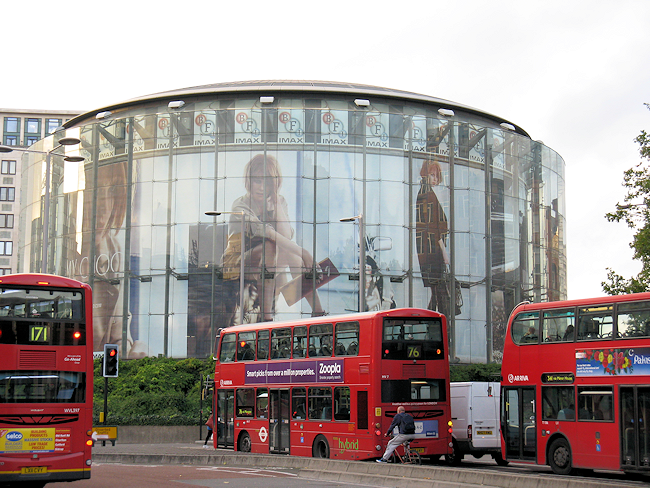
BFI IMAX Theatre
The BFI (British Film Institute) London IMAX was designed by Bryan Avery of Avery Associates Architects and completed in May 1999. It sits in the centre of a roundabout on Waterloo Road. Stamford Street is to the north-east, York Road is to the south-west and Waterloo Bridge is to the north-west. The IMAX screen is the largest in Britain (20m high and 26m wide). It has a seating capacity of just under 500 and a 12,000 Watt digital surround sound system. Although the site is surrounded by traffic and has an underground line just four metres below, the architects and engineers accounted for this in their design and the entire upper structure sits on anti vibration bearings to prevent noise transference.

The cinema won several awards at the time of opening, including a Design Council Millennium Product Award in 1999 and a Civic Trust Award in 2000.

In 2012, the screen was replaced and a digital IMAX projector was installed alongside the existing 70mm projector. In July 2012, the BFI announced that Odeon Cinemas had been selected to operate it for the next five years. This gives customers the opportunity to watch Operas on the giant screen. The BFI will retain a great deal of power over the cinema's operation, however, including parts of the film schedule and the technical operation, so the name of the building will remain the same.

We then caught the RV1 bus back to Covent Garden and met some Spanish-speaking tourists who were seeking Covent Garden as well, so we helped them get there.  Hubby tried to teach the gentleman how to read bus maps, but he spoke little English.  Even so, I think he understood.  Maybe.  They were grateful for the assistance and parted with us once we reached the Garden.  We walked into the center courtyard to find it decorated for Christmas already.

Covent Garden dressed for Christmas
We listened to the musicians for a while, then walked back to the flat where hubby prepared an excellent meal of roast chicken breasts, buttered potatoes with parsley, chives and mint, string beans and a mixed salad with cherry tomatoes and red onion.  Note the obligatory glass of wine, and guess whose plate he photographed.

Chicken Dinner
 Dinner was wonderful, so now I'm going to check e-mail, do a little work and call it a night.  Not sure what will happen tomorrow, but I've got Saturday Spankings to look after as well as read a few more Spank or Treat entries, which are wonderful excerpts.  If you're interested in reading some, go to my Naughty Blog and check out my Spank or Treat entry.  The other authors are all listed at the bottom in a small table.

Until tomorrow, good night.